


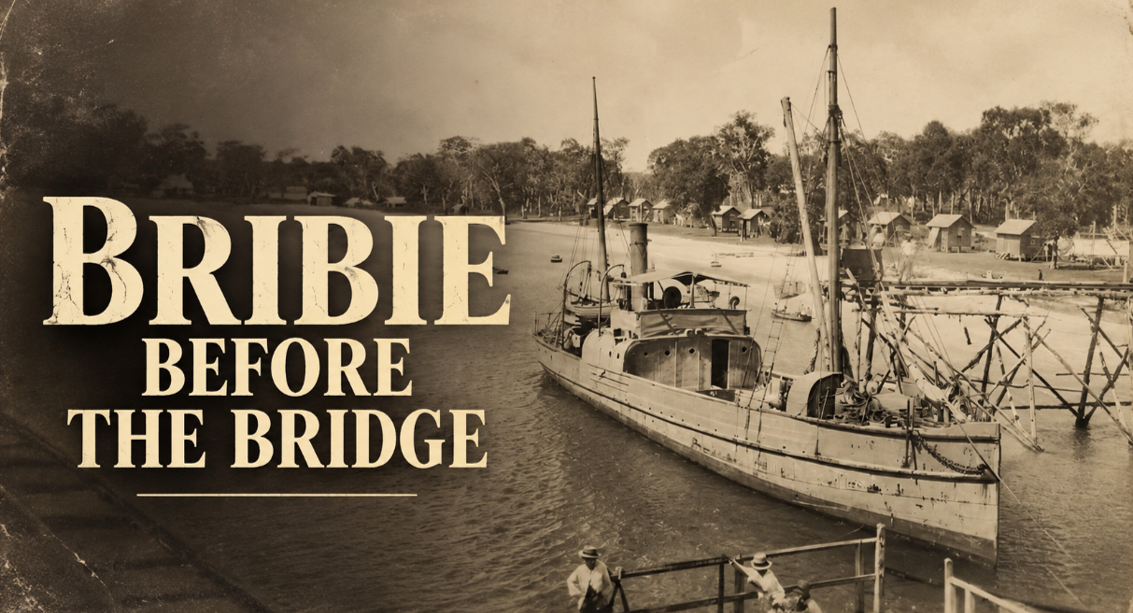
Before Bribie Island had its own permanent police presence, law enforcement could mean calling for officers from Caboolture — and waiting for them to cross the water.
For decades, the water separating Bribie from the mainland helped shape an image of an island beyond easy reach of authority — a place of holiday camps, temporary policing and, according to legend, escaped convicts.
The isolation was real. Some of the stories that grew around it are harder to prove.


The most enduring concerns the island’s own name. Tradition links “Bribie” or “Breiby” to a convict basket-maker, while other stories tell of escaped prisoners finding refuge on the island.
The surviving records paint a more complicated picture.


Tom Petrie recalled a prisoner known as “Bribie, the basket maker” in reminiscences published in 1904. Thomas Welsby later developed the story but could not establish the man’s identity. Bribie Island Historical Society research has also found no convincing match in Moreton Bay convict registers.
An official letter from August 1836 already refers to “Breiby’s Island”. Queensland’s place-name record says the name was “probably derived” from a convict called Bribie or Breiby, while another explanation links it to an Aboriginal word rendered as Boorabee. The precise origin remains uncertain.
Former convicts Thomas Pamphlett and John Finnegan were encountered at Point Skirmish by explorer John Oxley in 1823 after being shipwrecked. They were not fugitives from the Moreton Bay penal settlement, which had not yet been established.
Later stories tell of escaped prisoners reaching Bribie or disappearing “down with Bribie”, but the records located do not establish Bribie as a regular refuge for escaped convicts.


Whatever the truth behind the convict stories, Bribie’s isolation created a much more practical problem once large numbers of holidaymakers began arriving: who was going to police them?
Read: Seven Margate Beach Picnic Shelters Set for Renewal
When Bribie needed a Christmas policeman
In December 1920, a correspondent to The Brisbane Courier estimated about 2,000 campers would spend Christmas on the island and called for a constable to be stationed there for a fortnight. Belongings, the correspondent complained, were disappearing from unattended tents.
By Christmas 1924, a constable was on Bribie as about 1,000 visitors occupied 170 tents. Contemporary reporting credited the officer with keeping the rowdier element under control.
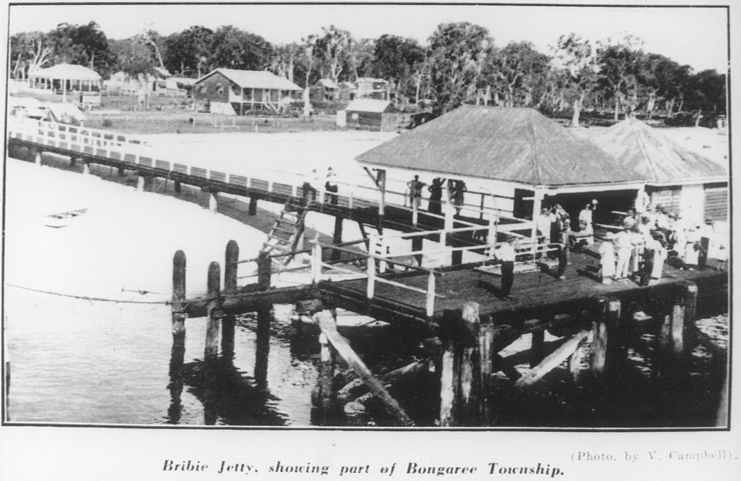
It was policing dictated partly by geography and partly by the calendar. Bribie’s permanent population remained small while steamships could suddenly deposit hundreds of holidaymakers at Bongaree.
Fourteen hours waiting for police
A temporary police station operated from a cottage at 4 Third Avenue, Bongaree, during the Second World War, but closed after the war.
The consequences of that isolation became particularly clear in 1946.
In August that year, 56-year-old fisherman William Milverton was found dead in Toorbul Street at about 9pm. Caboolture police were contacted, but officers did not reach the island by boat until about 10.30 the following morning.
A post-mortem reportedly found no suspicious circumstances, but the roughly 14-hour wait showed the practical problem facing an island without permanent police.
Another push for permanent policing followed a brawl in 1947. According to local historical research drawing on contemporary reporting, police considered Bribie’s residents generally law-abiding.
The distinction is important: Bribie was difficult to police. That did not necessarily make it lawless.
A permanent presence at last
Permanent policing finally arrived in December 1951, when a station was established in the Third Avenue cottage and a lock-up was built behind it.
Queensland parliamentary records from September 1952 support that timeline, recording that an acting sergeant had been transferred to the new station almost a year earlier.
By then Bribie was changing. Steamships had established Bongaree as a major holiday destination, car ferries brought vehicles across Pumicestone Passage and permanent settlement was growing.
Then, on 19 October 1963, the Bribie Island Bridge opened.
The island was no longer dependent on boats and ferries for everyday access to the mainland. For police and emergency services, as well as residents and visitors, the permanent road connection removed one of the geographical obstacles that had defined life on Bribie.
Read: Woody Point Beach Project Moves Into the Next Stage
What the records say — and what they don’t
Bribie’s isolation undoubtedly helped create its reputation, but the documentary record is less sensational than the folklore.
There were stolen belongings, rowdy holidaymakers and long waits for mainland police. There was also a mysterious convict basket-maker whose possible connection to the island’s name has never been conclusively established.
What the records do not demonstrate is a Bribie routinely beyond the law or established as a sanctuary for escaped convicts.
Even the later “Three Ds” reputation sometimes attached to old Bribie remains unproven without a reliable early source showing when, and by whom, the expression was actually used.
Before the bridge, the water separating Bribie from the mainland created genuine isolation — and left plenty of room for stories to cross the passage.
Published 16-September-2026
CLICK ANY LOGO TO SEE PUBLICATION