


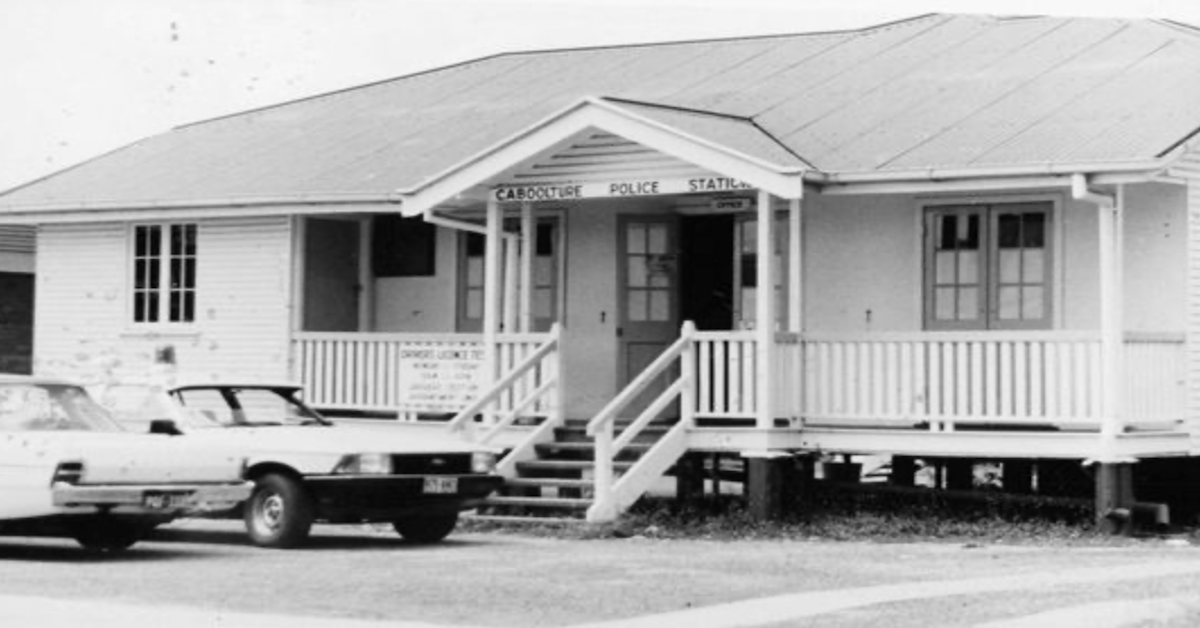
Caboolture’s early police had a fairly basic problem: there wasn’t much of a police station. The little timber building had just four rooms. Two were cells, but one doubled as a constable’s bedroom. Part of the kitchen became the Court of Petty Sessions.
From this unlikely base, police were expected to keep order across a district of farms, timber country and scattered settlements.
The cases that survive from those years are equally revealing: a watch and money disappearing at a local hotel, a railway station robbed of its takings, and offences that took the business of policing beyond the township.


Together, they offer a glimpse of what could go wrong in everyday Caboolture more than a century ago.


Before Caboolture Had a Proper Police Station
The government was considering a police presence in Caboolture by the end of 1869. In March 1870, Police Commissioner David Thompson Seymour was corresponding about sending a portable lock-up from Brisbane.
Queensland Police records date policing in Caboolture to 1871. Historical police annual reports cited by the Caboolture Historical Village record a station operating by 1872, staffed by a Senior Constable and a Constable.
Among the earliest officers identified in surviving local records are Sergeant Walker, registered number 77, and Senior Constable Thomas Robinson, number 316.
The available digitised records do not establish with certainty which man was Caboolture’s first individual policeman. What they do show is that a police presence was being planned by 1869–70 and a two-man station was operating by 1872.


Those officers had plenty of ground to cover.
Caboolture was still a small settlement surrounded by timber country and rural holdings. Even in 1891, the township had only about 248 residents.
Then the railway arrived in 1888, bringing passengers, freight, mail and goods through Caboolture — and another part of the district for police to watch.
A Watch, Half a Sovereign and a Hotel
One case began at Caboolture’s Royal Hotel in January 1889.
A man was accused of stealing a watch and half a sovereign from another man, with hotel barman George Bushell giving evidence in the case.
The matter progressed beyond the local Police Court. The accused was convicted before Judge Noel and sentenced to three years’ penal servitude. He later petitioned the Colonial Secretary maintaining his innocence.
By then, Caboolture’s police accommodation was also showing its age. In August 1889, 23 residents petitioned the government for a proper courthouse.
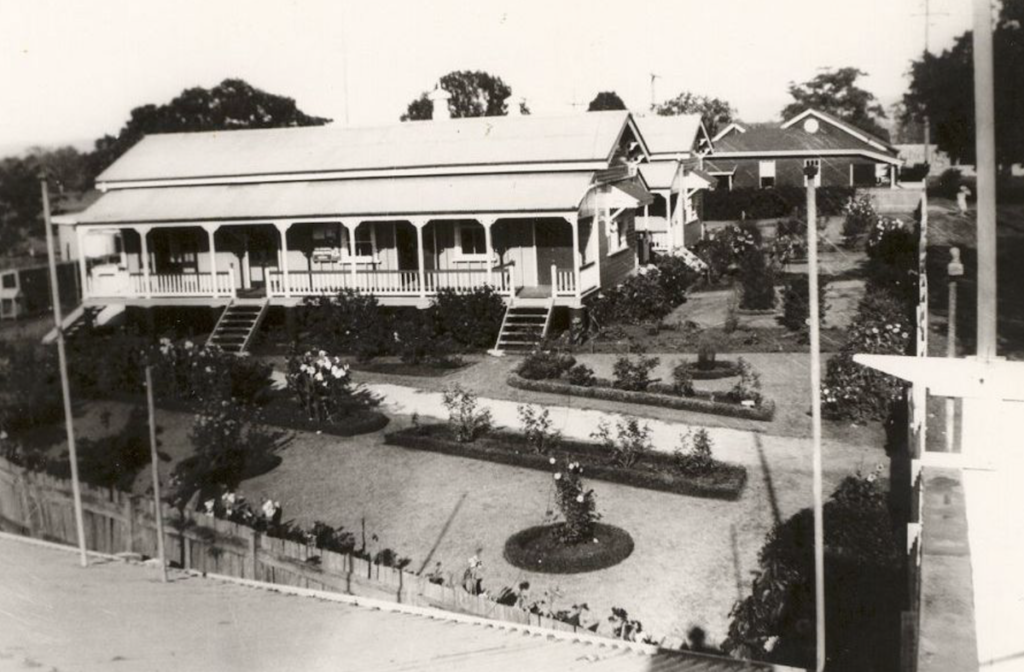
Tenders for new police and court facilities followed in 1891, with James Campbell Thompson securing the contract. Police, court and residential buildings would become part of the King Street government precinct.
Then Someone Robbed the Railway
On the night of 30 April 1894, Beerburrum railway station, about eight miles from Caboolture according to the Police Gazette, was broken into.
A cashbag containing between £60 and £70, along with £2 3s 3d in station cash, disappeared.
The offence appeared in the Queensland Police Gazette, which circulated details of the robbery and information about a person who had come under suspicion. The surviving entry records suspicion, not a conviction.
More than 30 years later, Beerburrum was again the setting for a case heard at Caboolture.
In September 1926, pineapple farmer Charles Levy pleaded guilty in the Caboolture Police Court to breaking into a Lands Department depot and stealing clothing valued at £35. Contemporary reports said he had been driving home while heavily intoxicated when the offence occurred. He was committed to the Brisbane Supreme Court for sentence.
These were not spectacular crimes. They revolved around the places where people actually lived and worked — hotels, farms, government buildings and railway stations.
The Lock-Up That Survived
As Caboolture grew, so did its police and court facilities.
Early photographs show police, court and residential buildings along King Street, while a separate courthouse was eventually built in 1950.
One piece of the old arrangement survives.
Caboolture’s two-cell lock-up, once behind the police station, was eventually moved to the Caboolture Historical Village.
It is easier to understand how small it is when you picture the district it once served: a few hundred people in town, farms and timber country beyond it, money moving along a new railway — and a constable sleeping in a room that could otherwise hold a prisoner.
Published 14-Sept-2026
CLICK ANY LOGO TO SEE PUBLICATION