





By Jack Mercer – Rabbit Hole Fisherman
In 1920, English migrant Charles Alvey began making fishing reels in a small shed in Brisbane’s St Lucia. More than a century later, Alvey reels continue to carry the name of a Queensland manufacturer whose practical approach to fishing equipment sustained a business across four generations of his family.
In This Story
- A Queensland Take on the Sidecast Reel
- Timber, Bakelite and the Brisbane Flood
- Two Closure Announcements and a New Owner
- Alvey Manufacturing Moves to New South Wales
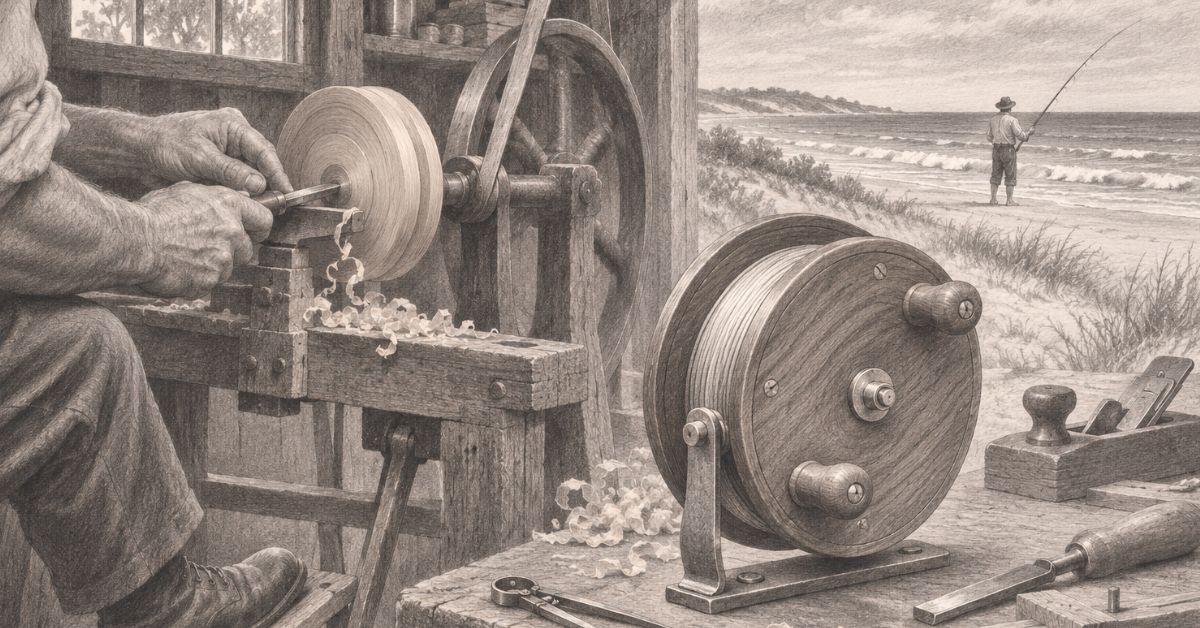
According to Queensland Museum, Alvey developed his reel design while working as a coachbuilder at the Ipswich Railway Workshops. His earliest commercial reels were made from silky oak using a foot-powered lathe.
The Australian Fishing Museum preserves a historical account that puts his initial production at about 20 reels a week, made in a workshop without electricity.


A Queensland Take on the Sidecast Reel
Alvey did not invent the sidecasting principle. Scottish reelmaker Peter Malloch had patented a sidecast reel in 1884. Alvey developed his own version of the technology and established an Australian manufacturing business around it.
Before casting, the angler turns the reel through a quarter-turn, allowing the line to unwind over the rim of a stationary spool. The reel is then returned to its winding position to retrieve the line.


This arrangement avoids the spool overrun associated with some rotating-spool reels. However, the Surf Casting and Angling Club of Western Australia explains that sidecasting introduces line twist, which anglers need to manage.
In an account published by the Australian Industry Group, Charles’s great-grandson Bruce Alvey described how contact between the fishing line and an angler’s index finger helped detect small bites. The manufacturer also warns that braided fishing line can cut fingers and recommends suitable finger protection.
Timber, Bakelite and the Brisbane Flood
Production methods evolved as the business expanded. According to Alvey’s corporate history, its earliest reels measured three or four inches (approximately 76 or 102 mm) in diameter. A kerosene-powered lathe later supplemented the original manufacturing equipment, and by 1936, Bakelite was being used to mould smaller spools.
During the Second World War, the factory’s machinery was adapted to produce vehicle and aircraft components. Charles died in 1945, the year reel production resumed.


His son Ken continued the business, followed by grandson Jack, who joined in 1946. Jack’s involvement in competitive fishing helped maintain contact with anglers whose suggestions informed changes to the reels.
The 1974 Brisbane flood severely damaged the St Lucia factory. According to the Australian Fishing Museum, members of the public and fishing clubs helped with the clean-up, allowing manufacturing to resume about two months later. The business relocated to larger premises at Carole Park in 1978.
Two Closure Announcements and a New Owner
By 2017, the business was struggling with declining sales and rising costs. Bruce Alvey, who ran the company alongside his brother Glenn, told ABC News that the longevity of its products limited repeat purchases. He also acknowledged changing fishing habits and insufficient sales to sustain operations.
Among the customers who visited the factory following the closure announcement was Stuart Peall, who recalled learning to fish with his late father using Alvey reels.
The business continued, with Con Athans becoming a majority shareholder in 2018. In 2022, material costs, supply difficulties and pandemic-related disruption prompted another closure announcement.
In December that year, ABC News reported that Australian investment company Gowings had acquired Alvey, allowing the business to continue.
Alvey Manufacturing Moves to New South Wales
Gowing Bros. Limited’s financial reporting for 2026 records the relocation of Alvey’s manufacturing facility from Darra in Queensland to Woolgoolga, near Coffs Harbour in New South Wales. Its 2026 annual report reports that the manufacturing move has been completed.
In August 2026, Gowings Pacific Trader published an account of the redesigned Direct and Drag reel ranges. Among the engineering decisions was the retention of an imperial fine thread in the drag mechanism, based on the company’s assessment of its operation.
The manufacturing equipment and materials have changed considerably since Charles Alvey began working with timber in St Lucia. The quarter-turn casting arrangement remains a recognisable feature of the Australian reel design he developed in 1920.

CLICK ANY LOGO TO SEE PUBLICATION